Cycle No. 04 · Narrative
Schlesinger Jr. — liberal/conservative cycle
~30-year alternation of American politics between 'public purpose' (liberal/reform) and 'private interest' (conservative/consolidation) eras; the phase lengths are historical approximations of roughly 15–17 years, not fixed half-waves
Does it hold up?
Not testable on the record that exists — and that is the finding, not a dodge.
The paired record (US Policy Mood (Stimson)) runs 72 years: 2.4 of the 3.0 full periods this site requires before it will run a test on a 30-year claim. Roughly 18 more years of that measurement would reach the floor.
This is not a verdict about this theory in particular: 0 of the 9 paired constructions on this site clear that floor. Long-cycle claims are hard to test because the records are short, not because the theorists are careless.
- Period
- 30 years
- Reference peak
- 1970
- Paired data
- Policy Mood
Peak calibration
Midpoint of the most recently completed liberal era in the conventional tabulation of Schlesinger Jr.'s scheme (1962–1978). The midpoint is this project's construction, not a peak date Schlesinger states. Taking the midpoints of his dated liberal eras gives roughly 1910 (Progressive), 1939 (New Deal), and 1970 (1960s/Great Society) - intervals of 29 and 31 years, averaging 30 - which is where the 30-year period comes from. The framework descends from Arthur Schlesinger Sr., whose Paths to the Present (1949) tabulated eleven alternating liberal and conservative periods through 1947 averaging 16.55 years each, implying a same-mood recurrence nearer 33 years; his son's streamlined twentieth-century scheme runs closer to 30, and 30 is what is plotted. Note: Schlesinger Jr. himself expected the next liberal turn shortly before or after 1990; a strict 30-year clock from 1970 puts the next cosine peak at 2000. His own forecast and his own period disagree - a plain demonstration of how sensitive a fixed sinusoid is to the anchor and period chosen.
CaveatUS-only periodization; like Huntington and Strauss-Howe, this is interpretive history, not measurement. Schlesinger's own ~1990 forecast for the next liberal turn does not align with the 30-year-from-1970 sinusoid - read the curve as a stylization of his stated period, not as Schlesinger's own prediction. The paired Stimson series measures mass preferences over the scope of domestic government - one component of his public-purpose/private-interest rhythm, not the whole of it.
Confidence classification: Narrative — an interpretive reading of history — no statistical fitting behind the period. Every cycle on this site is a pure sinusoid built from the theory's stated period and one documented reference peak — a deliberately naïve construction, so that disagreement between theories rather than parameter fitting is what you see. See about for why nearly every cycle peaks near the present.
Where this curve plots its extrema
Computed from period 30 and reference peak 1970, across the site's default window (1600–2050). These are positions of this construction, not dates claimed by the theorist.
- Peaks
- 1610 · 1640 · 1670 · 1700 · 1730 · 1760 · 1790 · 1820 · 1850 · 1880 · 1910 · 1940 · 1970 · 2000 · 2030
- Troughs
- 1625 · 1655 · 1685 · 1715 · 1745 · 1775 · 1805 · 1835 · 1865 · 1895 · 1925 · 1955 · 1985 · 2015 · 2045
Paired data series
US Policy Mood (Stimson)
index (higher = more liberal)Stimson's Policy Mood index - composite measure of US public preference for liberal vs. conservative domestic policy, estimated from ~150 repeated survey items via the dyad-ratios algorithm; annual, 1952–2024
Why this pairingThe closest thing on this site to a direct measurement: an independently constructed index of mass preferences over the scope of domestic government, which is one component of Schlesinger Jr.'s public-purpose vs. private-interest rhythm, not the whole of it. Stimson's own reading of the series stresses shorter, thermostatic swings rather than a fixed ~30-year cycle; the pairing tests his data against Schlesinger's period, it does not report his endorsement of it. Coverage starts 1952.
- Source
- James A. Stimson, Policy Mood data series (UNC), via Public Opinion in America (Westview, 2nd ed., 1999) and ongoing updates
- License
- freely shared by author; no explicit reuse license
Spectral verdict
Insufficient data — no test possible · 2.4 of 3.0 required periods
The US Policy Mood (Stimson) record spans 72 years — 2.4 of the 3.0 full periods this site requires before testing a 30-year claim. No test was run and no p-value exists: the honest verdict is that the record is too short to test the claim at all.
INSUFFICIENT_DATA is an eligibility outcome under the site's pre-registered 3.0-period rule - the test is declined, not failed - and is not evidence for or against the theory.
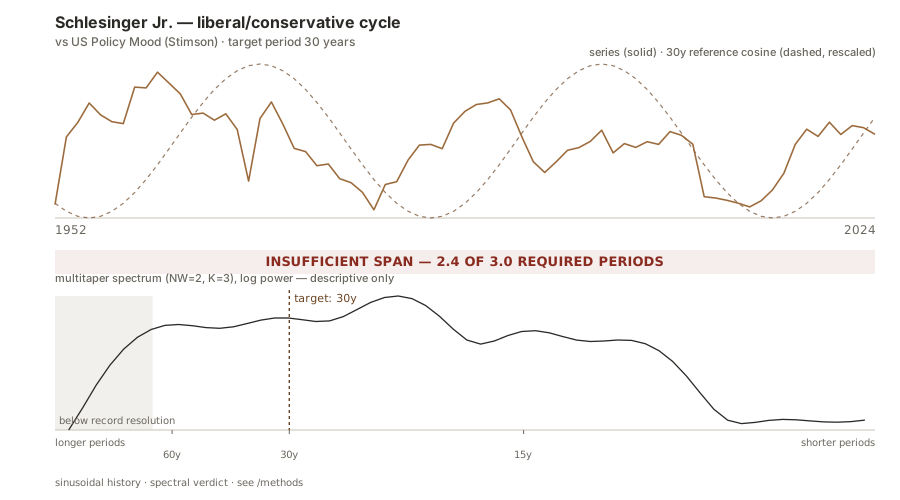
Pre-registered harmonic-regression test at the exact stated period against an AR(1) red-noise null (99,999 bootstrap draws), gated on the record covering at least 3.0 full periods. Read the protocol under spectral testing on the methods page, or fetch the machine-readable verdicts.json.
Reuse this
Kooi, D. (2026). Sinusoidal History: Schlesinger Jr. — liberal/conservative cycle. https://sinusoidalhistory.com/cycles/schlesinger-jr · DOI 10.5281/zenodo.21998618. Paired data series: US Policy Mood (Stimson) (James A), freely shared by author; no explicit reuse license.
Our code and the original chart files are MIT-licensed as our own work. The plotted data stay under their upstream terms, listed above: CC BY series carry their attribution requirement with them, and a series with no explicit license is shown here without any grant we can pass on. Reuse our figures and code with attribution; honour the data terms for the plotted series.
Open this cycle in the interactive chart to calibrate its peak and period against the data, or compare it with the other nine on one axis.